"Holy F-"
This happened to me today: Be happy you're all alive and in good health. This kind of shit isn't funny. (Click to enlarge.)
This happened to me today:Be happy you're all alive and in good health. This kind of shit isn't funny. (Click to enlarge.)
On October 4th...
I am also happy to say that I wrote this email to friends, September 23rd, 2004—nearly two years ago, immediately after viewing Lost's pilot episode:
I'll tell ya, it's going to be a great series—I would wager a crisp $100 bill that this time next year everyone on that show will be famous and it will be ABC's flagship show. J.J. Abrams really knows how to write 'em.
 *** The only sucky thing is that Lost will go off the air from November 15th until mid-Februrary to let Taye Diggs' new show Day Break take Lost's timeslot. The silver lining, however, is that while Lost is on the air, there will be zero repeats. Still, two and a half months off the air? As Mutley used to say, "Raffle ruffle raffle..."
I snapped this pic of my dashboard today:
I love advertising Price of The Pacific not just because I was a Story Consultant on it, but because Scott has worked on almost every film I've worked on, sometimes by complete coincidence. He's also written seven full-length feature scripts. And he likes chess.
So here he is, Scott Chema, writer/director:
He's so mellow.
When I was 9, Saturday Night Fever exploded into theatres and it was so popular that everyone was talking about it. I couldn't go because it was rated R. While unprecedented, it wasn't long before the studio recut a PG version, and I finally got to see it, even if it wasn't "pure".
This court ruling doesn't pertain to children, but to adults—Christian adults. It's sad, in a way... now Christians won't be able to see even an edited version of something like Titanic. Still, they can always leave the theatre to get popcorn if the sex or violence gets too intense. Or maybe they can choose not to buy a ticket at all?
Axing sex, swearing from films violates copyright: court
Last Updated Sun, 09 Jul 2006 10:47:31 EDT
CBC Arts
Deleting swearing, sex and violence from films on DVD or VHS violates copyright laws, a U.S. judge has ruled in a decision that could end controversial sanitizing done for some video-rental chains, cable services and the internet.
The ruling stemmed from a lawsuit brought by 16 U.S. directors — including Steven Spielberg, Robert Redford and Martin Scorsese — against three Utah-based companies that "scrub" films.
Judge Richard P. Matsch decreed on Thursday in Denver, Colo., that sanitizing movies to delete content that may offend some people is an "illegitimate business."
The judge also praised the motives of the Hollywood studios and directors behind the suit, ordering the companies that provide the service to hand over their inventories.
"Their objective ... is to stop the infringement because of its irreparable injury to the creative artistic expression in the copyrighted movies," the judge wrote. "There is a public interest in providing such protection."
The act of sanitizing films began in 1998 when one company, Sunrise Family Video, started deleting the scenes showing a nude Kate Winslet from the blockbuster Titanic.
Several other companies, mostly in Utah, quickly sprang up to follow its lead and there are currently an estimated 90 film scrubbing companies in the United States.
Directors applaud ruling against 'unauthorized editing'
Michael Apted, the president of the Directors Guild of America, said directors could feel vindicated by the decision. "These films carry our name and reflect our reputations. So we have great passion about protecting our work... against unauthorized editing," said Apted in a statement on the guild's website.
"Audiences can now be assured that the films they buy or rent are the vision of the filmmakers who made them and not the arbitrary choices of a third-party editor."
Scrubbing companies vow to continue fight
Matsch ordered the companies named in the suit — CleanFlicks, Play It clean Video and CleanFilms — to immediately stop producing, creating and renting out the scrubbed films.
"We're disappointed," said Ray Lines, the head of CleanFlicks. "This is a typical case of David vs. Goliath, but in this case, Hollywood rewrote the ending. We're going to continue to fight."
Today I got this email from my mom:
Ross, huge gas explosion demolished/totalled 20' townhouse @ 32 East 62nd. BROWNING is @ 52 E. 62nd. 2nd Bldg away is Browning. I called Browning. No students expected 2day. Browning is OK & students expected to return 2morrow


Having grown up in an ambulatory city like Manhattan where you can walk for 5 or 6 blocks and actually be somewhere interesting, I really loathe the suburbs. Sure, I've gotten used to the burbs, but feeling constantly chained to my wheels to get anywhere is... well, idiotic. It's simply bad city planning.
There's an undeveloped lot right to where my wife and I bought our swanky new condos. (Yes, condos—neither of us cares for yard work, and in a condo we actually feel like we're part of a community, even if we don't talk to our neighbors that much.) Every day we drive past this dry stretch of land, and every day we cross our fingers that it will soon host a coffee shop or a produce market or a bookstore—whatever. Anything useful which we can walk to. As much as we love our cars, we love walking around more... and not just to see the park, but to buy things. Like milk. Or croissants. Or half-caf/half-decaf non-fat iced lattes.
Cities evolve naturally according to its inhabitants' needs. My old real estate mentor once described how the center of a major city is the business node into which everyone commutes. As that center grows, housing nearest those core businesses becomes more in demand and prices go up. As prices go up, people move farther away to buy cheaper housing. This cycle continues until the commuting distance becomes too far and they choose to look for other work... closer work. This is how newer, smaller cities are born on the outskirts of a big city. And how large cities "die" and become reborn: fewer people commuting to the center of town means lower demand on housing nearest that business hub and its smaller businesses going under, which is why housing in the center of town and old businesses become renovated into residential "lofts".
Now it appears there is a growing trend towards high density living away from big city centers, and not based around cars. And while it sounds a little too Utopic, I can't deny that it does have a distinctly more amiable approach than sprawling suburban housing. Which I'm okay with. But, like Tom Skerritt said to Campbell Scott in Singles, "People love their cars." It will be tough to ween people onto public transit. Suq.
Here's an entire article about these "New Villages". Look for my boldface:
The next real estate boom
Dense settlements, not sprawling ranch houses, are the future of housing - and could make for a smart real-estate investment.
By Chris Taylor, Business 2.0 Magazine senior editor
July 7 2006: 2:50 PM EDT
SAN FRANCISCO (Business 2.0 Magazine) -- Picture the scene: it's 2025, and you and your family are living in a beautiful, leafy-green village that seems more 19th century than 21st, even though it has only been in existence for ten years and is just 20 miles from a major American city.
You know all of the 150 or so souls in the village; you see them at the market where you pick up a box of locally-grown produce once a week. You see half of them in the morning as they board the commuter train for school or work in the city; the other half are the network warriors who work from home or, on warm days, use the free Wi-Fi in the village square.
It all seems a world away from the crumbling old 20th-century suburbs people used to live in, if you could call it living. You shudder to think you could still be living there. Oh, and you see that really nice house just down the bicycle lane? That's yours, the fruits of your smart move to plunk down a payment on a piece of the hottest new trend in real estate.
Streetcar stops desired
Sounds like a far-off future? You can already see such a development opening up in Hercules, Calif., 20 miles northeast of San Francisco. And you can bet on seeing many more across the country if changing consumer desires and economic trends dictate the direction of the housing market.
"New Villages," as community planner Robert McIntyre dubs them in the latest issue of The Futurist magazine, are compact, pleasantly urban settlements located well away from city centers. They share some of the charms and amenities of cities, thanks to their density, but have the mostly rural surroundings that originally drew people out to the suburbs, as well as the friendly feel of a small town where you know your neighbors.
The concept of New Villages shares some similarities with the so-called "transit villages" you can already see around the country. Starting in the mid-'90s, when architects and local planners became more interested in more pedestrian-friendly, urban developments, transit villages started to spring up outside cities along revitalized rail lines, from Mission Valley near San Diego, to Ballston and Bethesda outside Washington, D.C.
They were very attractive to young city workers and empty-nest parents. Their defining characteristics: They were eminently walkable, densely constructed without feeling overcrowded, and offered a real community feeling with plenty of common spaces.
The difference between transit villages and New Villages is location: While transit villages mostly reinvented older suburbs that are close to cities, New Villages promise to reinvent the sprawl further out.
The demand for such developments is real, and it's only going to get greater as consumer preferences rapidly shift away from the McMansions preferred by boomers. According to a study by the nonprofit Congress for New Urbanism, while less than 25 percent of middle-aged Americans are interested in living in dense areas, 53 percent of 24-34 year olds would choose to live in transit-rich, walkable neighborhoods, if they had the choice.
Demand for housing within walking distance of transit will more than double by 2025, according to another nonprofit, the Center for Transit-Oriented Development. Even now, properties within a 5- or 10-minute walk to a train stop are selling for 20 to 25 percent more than comparable properties further away - a price premium that's likely to increase as traffic jams worsen.
And as the effects of the Internet continue to kick in, it won't be so necessary to be in the big city - you'll just want access to it every once in a while, for the occasional business meeting or nightclub outing. But as social animals we'll still want to cluster together for face-to-face contact, local food and local culture.
The payoff
All of these consumer trends suggest that New Villages just may be the future. But there are also compelling economic arguments for developers to build and sell such properties, as well as for consumers to buy them.
Rising oil prices notwithstanding, sprawling car-culture cities and vast suburbs simply do not make economic sense in the long run. As much as 50 percent of the land surface area in any given city or subdivision - we're talking prime real estate - is taken up by roadways. For developers, less space given over to roads means more space for housing.
Not only are roads a drain on landlords' potential income, they're a turnoff for residents -- and are only going to become more so as gridlock, road repairs and air pollution increase.
While you might assume that a higher density community would have more traffic, you'd be wrong. When neighborhoods are dense and walkable, studies show, people make fewer car trips. And some may even forgo owning a second car, especially as families realize that living with one less car can save them $6,000 a year on average (and again, that's not counting price rises at the pump).
And then there's simple math. While standard subdivisions have five units per acre, transit villages tend to pack in 20 to 25 per acre - still mostly single-family dwellings or townhomes, but without the vast lawns and backyards of suburbia. And with transit village homes selling for more than similar houses in traditional, sprawling suburbs, developers will make considerably more per acre, while fostering community and being kinder to the environment.
Pocketing a nice real-estate gain while saving the planet? That should help you sleep very well at night in your nice, safe, quiet, neighborly New Village home.
 I recently saw these pics from NASA visualizing their revised designs for space exploration. (The pic at left is one of them. Go ahead and click it see the hi-res version.) I love all things about space... I'm a severe Trek fan, after all. Still, as I'm looking at this picture, I'm thinking—okay, cool, but... so what? Haven't we already been to the moon?
There are arguments, I'm sure, why we should go back to the moon. Technology is better, we're just starting to understand things with science that we never have before... I get all that. I simply haven't heard any of the reasons why we would spend billions of dollars to go back, when we can redirect some of that moola to, say, reducing global warming on our own planet. The space station, at least, is a good testing ground for scientific experiments. The moon is just a big rock, in my view.
Maybe I'm getting old, but I feel like there are certain things I can visualize well enough that I won't have to do them in real life. I'm not counting my visit to the Mayan pyramids—it's far too humid to not experience that for yourself. It's simple things like, I wonder what it would be like to stand up there? and I've done enough similar things that I can close my eyes and imagine it to my satisfaction.
Egads, just listen to me today! Most of the dramatic discoveries happened amidst directionless exploration. When the Europeans discovered the American continent, for instance. Maybe there are rock samples on the moon that will help us gain a better understanding of Earth's geology. I hope so. What we should really be doing is terraforming Mars to colonize it. And pronto.
In other news, Dave and Nancy had their baby:
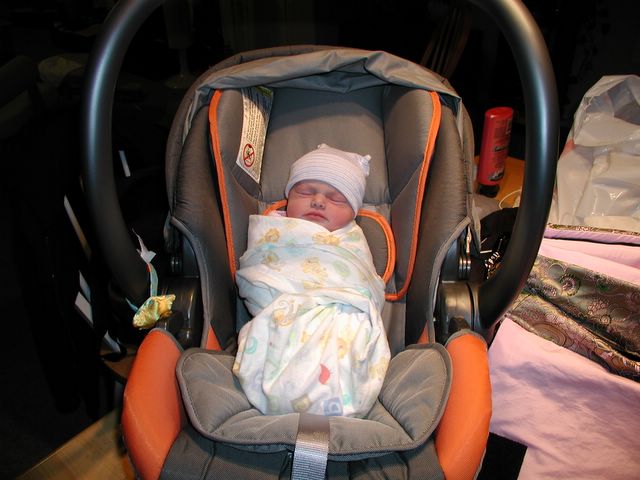
I guess children are the greatest exploration of all, huh?


