Tuesday, January 23, 2007

Safe Harbors Update

So many of you have been asking me... and it's true—work has finally resumed on Safe Harbors, my 90% CGI feature film. Part of what's taken so long is crafting a backstory with enough layers so as not be cliché, but not brainy and convoluted for its own sake. Maybe one month I'll come up with a great idea, something to add to the layers of the onion to peel back as a major plot reveal, then many months later come up with another cool reversal that adds more texture and unpredictability. Add, subtract, add, subtract, add, subtract. I'm confident the end result will be compelling.

It's helped a lot to listen to Ron Moore's writer room podcasts behind Battlestar: Galactica about Season 3 where you get a glimpse of how one of TV's best sci-fi shows is hammered together one episode at a time. Frankly, I was shocked to discover Moore had such a vague idea of where BSG was ultimately headed. The way I see it, you have to know a little more clearly where you're going than that. But I'm not Ron Moore. Yet.

The plain truth of it is that Safe Harbors' rich setting can generate enough story material to spit out a TV pilot, a series and a major motion picture (or three). So the scope of the backstory, covering hundred of years, was so vast that I couldn't get my head around it. I needed a visual aid, some way to see when events happened and how they affected later events on the timeline.

Our world consists of patterns: scientists uncover the patterns hidden in nature or throughout history and artists create patterns in a story for a viewer to uncover. The best artists forge patterns as precise replicas of patterns found in nature, either resonating some inner truth (the metaphysical) or some outer truth (the physical).

In order to create a story, a real story that's convincing enough to let your characters roam around in, you need to create a realistic history. In my case, quite literally—I needed to create a historical timeline for my false universe. So I found a way to create a mutable timeline in Excel to tinker with dates, moving entire sections of the story forward or back in time as needed. At left is an actual closeup of a part of my timeline, though I've excised the identifying bits so you can relish them later...

Robert Heinlein created an interesting sci-fi universe by writing one story at a time over his career. Heinlein advanced each story slightly ahead in time of his previous story so that he could refer to characters from previous stories, which elevated his individual stories into parts of a much larger whole. While he may not have intended it, his short stories were eventually compiled into a Future Histories book.

Here, check out my Excel spreadsheet timeline:

Friday, January 19, 2007

We take filmmaking EXTREMELY seriously

These are the people I work with:


We make movies. We don't mess about.

Fun with color correction

I've used Photoshop for 20 years and while I'm still far from being an expert, a small color correction can really improve a picture's quality. I did color correction on some photos for a friend's web site and thought it'd be fun to share a couple of the results. I'm sure I could easily sink another hour of work into each, but you can already see the difference after 10 minutes of tweaking.

Before color correction:


After color correction:


The ocean is still too green, but I'd have to mask her out to do a proper color correction, which is another 15-20 minutes.


Before color correction:


After color correction:


Doesn't it look like a thin grey veil has been peeled off the original? Few people really understand the value of color correction until they see results like this.

Thursday, January 18, 2007

Here it comes...

Netflix is finally making good on its promise—they're offering instantly downloadable movies through their web site:

LOS GATOS, California (AP) -- Netflix Inc. will start showing movies and TV episodes over the Internet this week, providing its subscribers with more instant gratification as the DVD-by-mail service prepares for a looming technology shift threatening its survival.

The Los Gatos-based company plans to unveil the new "Watch Now" feature Tuesday, but only a small number of its more than 6 million subscribers will get immediate access to the service, which is being offered at no additional charge.

You just know Blockbuster's techies are scrambling to catch up, but this is only the most recent salvo in the struggle to provide disposable digital entertainment. If I can buy a movie for $1.99 through iTunes, why would I want to view it on my laptop? Because I don't want to keep 500 terrabytes of movies on my hard drive. Netflix is still the best way to see a large quantity of movies without worrying about late fees or where to store the DVD case. Now, because you can download a movie to your laptop, it doesn't even matter where you are.

One day, hopefully, consumers will be able to buy a "right" to view a particular movie at any time, and then downloading movies whenever you want to see them will at last become the new business model for digital entertainment distribution. This will cut out the annoying format upgrades we seem to go through about every 10 years (VHS to DVD to Hi-Def to Blu Ray to WTF!!!), but which means less money for DVD manufacturers and duplicators. All I can say to those poor storefront souls is... this is the world we live in now, people. Adapt.

Monday, January 15, 2007

A Royal Abstract

Although he's packing his bags for Iraq, there's still some question whether Prince Harry will really see any combat:

The defense ministry has previously confirmed Harry could go to Iraq if his unit was deployed there, but said he might be kept out of situations where his presence would jeopardize his comrades.

Hey, be real—how many Iraqi insurgents are really going to recognize Prince Harry? Even if terrorists had a picture of him pinned to their RPG turrets, I mean... seriously. Not going to happen.

But it got me thinking. This guy is royalty. And, as an American, I kind of have a problem with the whole idea of royalty: my country was founded on the vitriolic denial that any person is "more equal" than anybody else. No one should get special treatment... ever. Of course, that's an ideal to strive towards in an imperfect world, but inequity has been on my mind recently, especially about political leaders.

On NPR's Fresh Air the other day, House representative Rom Emanuel was asked about his involvement with the Clinton impeachment, and he quickly interrupted—"I just want to say that I found the whole situation incredibly tense and thought Clinton should have resigned. I never once had a problem with his affair, but lying under oath was really unforgivable. As a leader, I felt he had a duty to set an example for the rest of us and I thought lying under oath was incredibly irresponsible of him." Few people seem to remember that Clinton wasn't just a leader, an elected official, even the President, but he was also a lawyer—he, above all others, knew the import of lying under oath and should have had the decency of not trying to argue the meaning of is. If you're guilty, do what everyone else does—plead the 5th. Or resign your position. Because if one person can get away with lying under oath, then I'll be expecting my own "Get out of Jail free" card in the mail this week.

I once asked a foreigner what they thought I was feeling when I saw Clinton testimony broadcast on national TV... they had assumed I was ashamed. While that's partly true, I wasn't ashamed for having America's dirty laundry brought into the open; I was ashamed that Clinton had brought this mess into the spotlight to tarnish America's image. Thus, quite to the contrary, I was fiercely proud that America's judicial system was healthy enough to prosecute our highest elected official for his illegal actions. (To clarify, my position is 100% apolitical—Nixon and Clinton should have shared jail cells.)

And this last week, Gerald Ford died. America's period of mourning for a president is six days. Not to be a party pooper, but that's five days too many. President or not, Ford was just a guy.

When I said that last bit to my wife, she looked at me and said, "He's not just a guy."

And that's the problem.

Novelist Margaret Atwood has said she's in favor of a monarchy, not because she wants some random family touting undeserved priviledges, but because our human nature drives us deify our leaders... which then makes it difficult to critisize them and still seem patriotic. Instead, Atwood would prefer a generic head of state to draw praise and awe so our elected leaders can serve the function we've assigned them—to be our servants, not our masters.

Governments already sort of solve this problem, in their own way. America has a president and a chief of staff. If the shit hurled at the president gets too thick, the chief of staff gets swapped out. France has a president and a prime minister (President Mitterand went through about 7 prime ministers during his 14 years, if memory serves). Et cetera.

Reality check, though: the presidency is not made up of one man or one woman—the presidency is only a position (albeit an important one). Why is this important? Because you can kill a man, but you can't kill a presidency.

So after Ford left office, what's with calling him "President Ford"? It's that deification Atwood talks about. It's why America and other democracies around the globe establish term limits for their most prominent political leaders.

Or imagine you've lived in Cuba for the last 40 years: if you're under 45, you'll have literally known no other national leader for your entire life. When Castro dies, you might not even care he's a dictator... since he's been the rock keeping your country afloat and now he's gone. God is dead. Nobody could ever replace him.

I don't want a monarchy, but it does bother me when I see flags at half-mast for a American president for nearly a week. He's not a Pope or a King with divine right. He's just a guy. And he should be treated like any other person who dies, with a day of morning. Maybe a couple of thousand years ago, we'd bow down and kiss the dirt he walked on... wait, that's another dude. Sorry.

The larger issue here is how we define our relationships to the objects and people around us, which is the central theme of existentialism: do we define things by their essence, by their meaning, by their abstractness... or do we define things by their experience, by their tangible concreteness, by their uniqueness? If we see an object or person as its essence, then its destruction is not a massive loss to us... whereas if we see an object or person only as its experience, then no other object or person can ever replace that loss.

For example, if the desk where the Declaration of Independence was signed were accidentally destroyed and an exact replica were put in its place, how would we react to seeing the replica? Can we "abstract" the replica and imagine the original desk? And is that good enough? Or are we bitter with remorse that the original—so unique in its creation—is gone forever?

Philosopher Martin Buber describes these two approaches as "I-it" relationship and an "I-Thou" relationship. The "I-it" relationship views the essence of a thing, the abstractness of it. To see things from an "I-Thou" relationship is to recognize that each chair and each carrot and each person is the only one of its kind. As my friend Jim Latham said, "If you had an 'I-Thou' relationship with everything, you'd never even leave the room." (And here's a bonus epiphany—movies where heroes remorselessly kill villains are "I-it" movies, like movies about ninjas, but movies where heroes have a conscience about killing their villain are "I-Thou" movies, like movies about samurais.)

Abstraction is the key. We abstract things of like kind: trees, cars, chairs, apples, etc. Words help abstract because they only define the similarities between items... but none of their differences. Words refer to the essence of things. There is, however, one case where words don't function as abstractions: a person's name.

People can't be abstracted. They are unique. They are one of a kind.

Or are they? Are they really?

Thursday, January 11, 2007

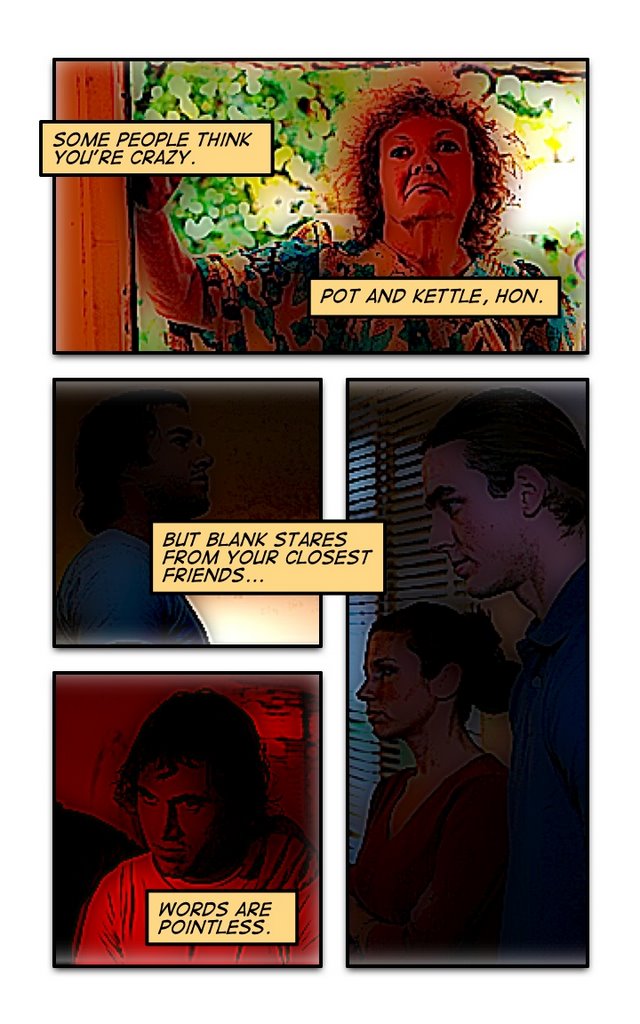
Lunatic Messiah Graphic Novel Tests

The producers of Lunatic Messiah are toying around with the idea of doing a graphic novel, which reminded me about Comic Life, the extremely cool graphic novel software bundled with my MacBook.

Since I'm doing publicity for the film, I already have about a gajillion photos from each shoot... and Comic Life makes it easy to import pictures from iPhoto and apply image filters to make each photo look like a graphic novel. The rest is pretty basic stuff, like selecting a font used for comic narration over the last 40–50 years.

Here are the results, a simple 4 page test. Took me about an hour. Click to enlarge:


Tuesday, January 09, 2007

Last Looks on Wiki

I made my first substantial Wiki entry today (unless you count correcting Wikipedia's improper uses of "it's" as substantial and if you do, I want to make babies with you!). There was a gap on the First Assistant Director page about Calling The Roll, an oft-overlooked but invaluable service on any film set. A good 1st Assistant Director who can efficiently steer your crew can make your life like butter. The world is a little shinier for all fledgling filmmakers now!

Here's a link to the page, but for posterity, here is the page in its current form; my additions are in dark green:

== Calling the Roll ==

One of the 1st AD's responsibilities is to "call the roll", which means that when all of the relevant HODs (heads of department) and Above the line (film production) people seem ready to perform a take, the 1st AD initiates the take. Over the years, special procedures have been developed for this task in order to achieve the maximum economy and efficiency during shooting, which is usually some variant on the following dialog:

1) WAITING ON... 1st AD's are constantly calling out which department is responsible for any delays. If the lights need to be adjusted, the 1st AD calls out, "Waiting on Grips" and if the actors are still in their trailer, the 1st AD calls out, "Waiting on talent", and if it's mascara smear, "Waiting on Makeup", etc. This step prevents much wasted time no matter the size of a film's budget.

2) LAST LOOKS, PLEASE. Once everyone is in place and rehearsals and blocking have finished, the 1st AD calls out "Last Looks" so everyone is given a chance to make last minute changes—to the set, to the hair and makeup, to the lights, anything.

3) QUIET ON THE SET. The take is ready to be filmed. The 1st AD calls out, "Quiet on the set." This alerts everyone that the take is ready to be filmed.

4) ROLL SOUND. The 1st AD waits for complete quiet, then signals the [[Production sound mixer]] to "Roll Sound", after which the Mixer rolls his sound gear, verifies it's working, and replies, "Rolling" or "Speed".

5a) ROLL CAMERA. The 1st AD then signals the DoP to "Roll Camera"; the DoP rolls his camera, verifies it's working by watching timecode for three seconds and replies, "Rolling" or "Speed".

5b) LOCK IT DOWN! Right before the DoP says "Speed", sometimes the 1st AD will also call out, "Lock it down!" to make sure nothing on set is dropped during the take because it wasn't "locked down"—everyone must now be totally quiet and move out of the frame.

6) MARKER. The 1st AD then signals the Clapper loader, or 2nd Camera Assistant (2nd AC), by saying "Marker" or "Slate it". The 2nd AC marks the shot by clapping the clapperboard, or slate, and reads it aloud to mark the scene for editing purposes): "Scene 67, Take 4".

7) The Director then says, "Action", although a 1st AD might perform this function if the Director prefers it.

Only the Director says "Cut".